From the Archive #6

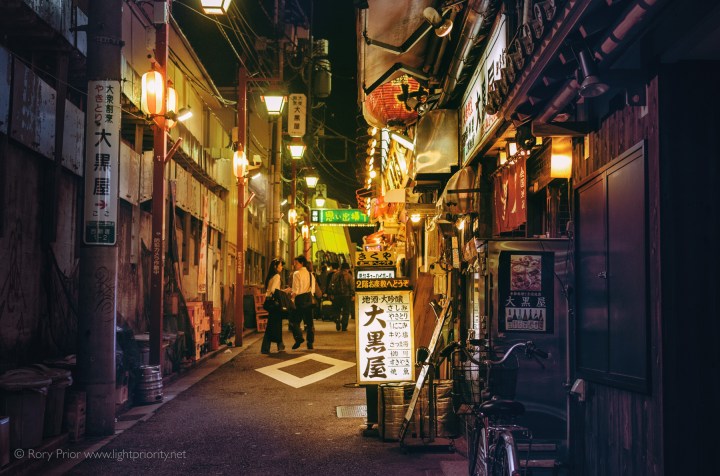
I recently came across the work of Masashi Wakui, a Japanese photographer who produces some wonderful stylised street photography of scenes around Tokyo. In particular I really love his nighttime shots which I feel do a great job of capturing the essence of the city. It gave me the inspiration to go back through my archive to see if I had any decent nighttime street scenes from my various Japan trips I could treat in a similar way. Many of the night shots I have from Japan were shot on a Nikon D90 which at best had middling low light performance and fairly poor dynamic range compared to today’s standards. This makes doing much of anything with them a fairly frustrating experience; blown highlights stay forever blown, and the shadows do little but yield noise when pushed. But a few images from my last trip in 2011, where I took a D7000 with me, came out better. This one from Shinjuku, shot near the charmingly named, but actually really quaint and interesting “piss alley” turned out quite well.

Daikokuya

Daikokuya
[exif id=”1050″]

Happy Halloween!

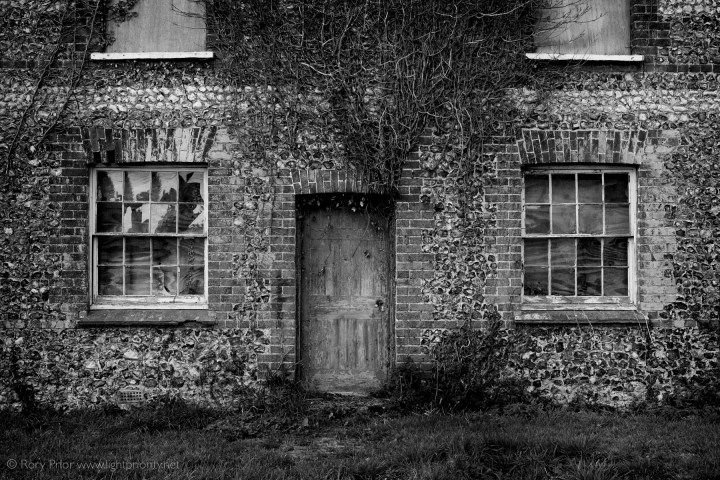
Apologies for the lack of posts lately, I’ve been busy with work and not had that many opportunities to go out with the camera. As Halloween is almost upon us I thought I’d post this recent shot which I think looks rather spooky. It’s an abandoned cottage near where I grew up that’s been empty for decades.

Haunted Cottage
[exif id=”1040″]

From now on I’m going to start uploading higher resolution photos so things look crisper on high DPI displays. As these larger images are slightly more vulnerable to misuse, I’m embedding a faint watermark in them. Hopefully the tradeoff in clarity is worth it!

Liverpool

Liverpool

Since moving up north three years ago, I’ve been meaning to visit Liverpool. Finally the opportunity arose last month, so I jumped on the train with fellow photographer and Fuji enthusiast Richard Gascoigne, for the one and a half hour journey to Merseyside.

I think it’s not a stretch to say modern Liverpool is most famous for The Beatles and its premier league football club, rather than its mercantile history. Like its northern siblings, it suffered a long painful period of stagnation and decline as traditional industries collapsed or were made obsolete. It’s only comparatively recently (the last 20 or so years), that serious efforts have been made to revitalise and regenerate the city. Its skyline now has its fair share of gleaming glass and steel office blocks, standing incongruously with elegant Victorian structures thankfully protected for future generations. Unlike in Leeds and Manchester, the process of regeneration feels less complete, and in many places appears stalled entirely. No where is this more evident than the sprawling northern docks. Listed buildings and world heritage sites lie surrounded by temporary barriers, or locked behind tall metal gates with vast swaths of empty land that no one seems to have much use for.

Luckily for me as a photographer at least, the pause in activity buys a little more time to document what’s been left behind. Indeed if you want to go and see what’s left before it’s all turned into impossibly expensive flats and great vacant office towers, your time is certainly running out.

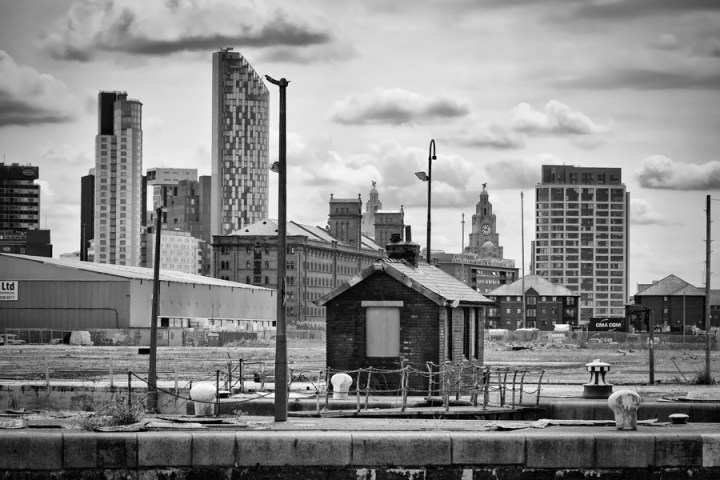
When I was researching where to explore in the city I came across endless shots of the Liver Building and the prettier bits of the waterfront. As a result I’ve made a conscious decision to avoid including images of them here. The parts of the city that interest me most are those that are living on borrowed time. The only glimpse you’ll get of the Liver Building here is in the background of a few shots. Given the limited colour palette and gritty feel in a lot of the images, I’ve decided to publish these all in black and white. This allows a bit more freedom in pushing the tones to bring out the texture and detail. For those interested, I’ve processed all the shots in Silver Efex Pro 2.
_DSF7153-2[exif id=”1008″]

As you can see above, much the dockland has been scrubbed clear. What little that is in use is home to light commercial and industrial buildings, huddled like imposters behind the grand old dock wall.

_DSF7177-2-Edit[exif id=”1009″]

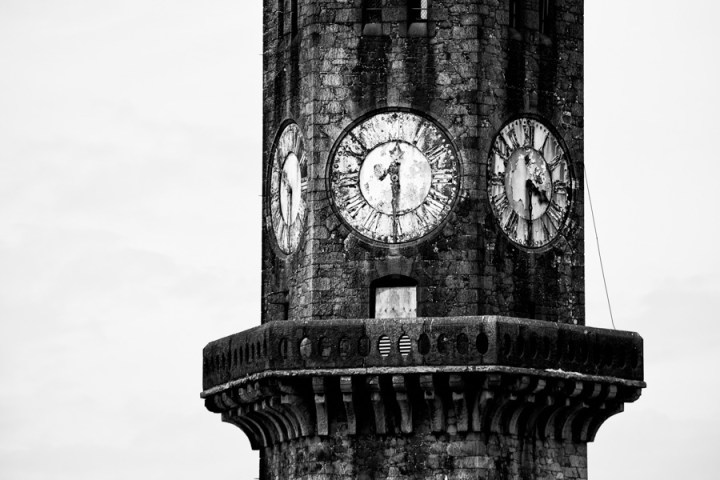
Amid the network of empty docks stands the impressive Victoria Clock Tower. It looks rather worse for ware, but as a Grade II listed building has been spared demolition. It was announced in 2010 that it was going to be repaired, but it doesn’t look like anything has been done in the five years since.
_DSF7151-2[exif id=”1007″]

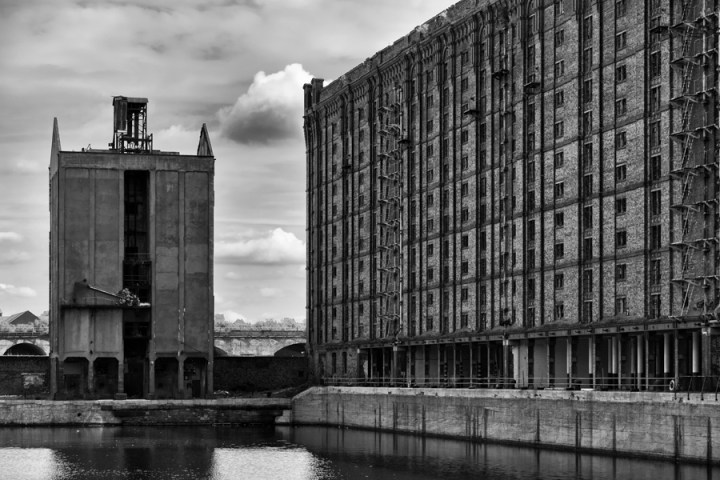
Another impressive and largely un-redeveloped area is Stanley Dock. Home to an old tobacco warehouse that is one of the largest brick buildings in the world. It boasts 14 stories and covers an area of 36 acres according to Wikipedia. It’s certainly vast and impressive even in its current state.

_DSF7131[exif id=”1006″]

_DSF7114-Edit[exif id=”1005″]

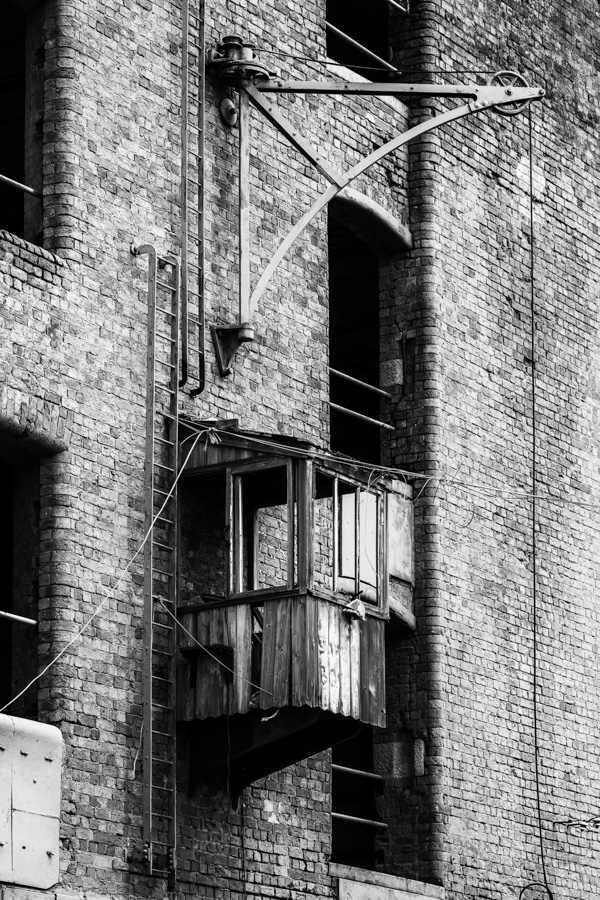
I presume this little booth, clinging to the side of the southern warehouse, was for the operator of the hoist that’s directly above it. It appears that you had to climb in through a window after scaling the ladder, not how I’d want to get to work every day! This is the sort of little detail that probably won’t survive redevelopment so it’s nice to have a chance to capture it.
_DSF7180-2[exif id=”1010″]

The northern side of the dock has been developed into a vast (empty looking) luxury hotel from where this and the following two images were shot. Surrounded by derelict industrial sites it feels rather out of place and a bit ahead of its time given the general state of redevelopment in the area. At the back of the dock is an old grain silo that’s in really poor shape. I’d be surprised if this isn’t torn down soon – either that or gravity will do the job itself.

_DSF7208-2[exif id=”1011″]

A straight side on shot of the Tobacco Warehouse gives you an idea of it’s huge scale. If you worked on the top floor I bet you wouldn’t have relished the prospect of using that fire escape! The steps are made from bars so you’d have been able to see straight down to the ground.

_DSF7216-Edit[exif id=”1012″]

Here’s a closer shot showing the rows of metal columns holding up the vast weight of all those millions of bricks. I hear a ‘heritage market’ used to be held in the space beneath the warehouse until 2011, I wish I’d had the chance to visit.

_DSF7234-Edit[exif id=”1014″]

Detail of the crane and slowly collapsing gantry on the side of the grain silo.

_DSF7291-Pano-Edit[exif id=”1016″]

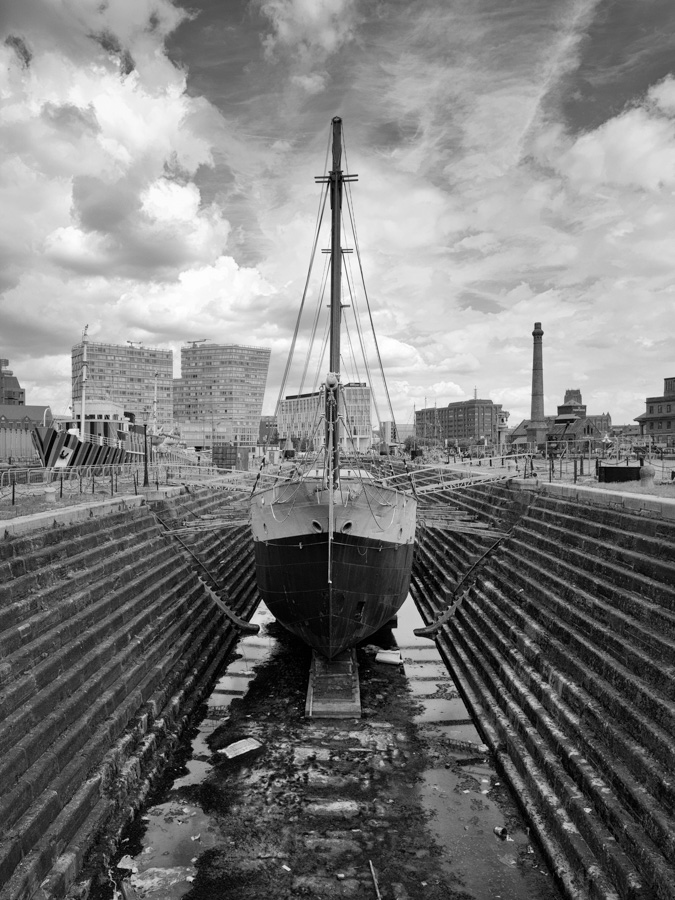
I was pleasantly surprised to see some interesting old buildings and features left around the Canning Dock area that look fairly untouched. The temporary fencing is out in force around here though, which makes photographing various parts more challenging. The Great Western Railway warehouse by the dry docks looks really nice and is in surprisingly good condition, leading me to wonder if its already been restored to some degree. Notice the great glass brutalist monster blocking the skyline behind it though.
_DSF7304-2[exif id=”1017″]

Both the dry docks were in use when I visited, but it was tough to get a good angle without prying apart the bars on the damnable temporary fencing to poke the camera lens through!

_DSF7318-2[exif id=”1018″]

Preserving historic buildings in this country usually means one of two things – turning them into trendy bars or expensive apartments. There are plenty of examples of both in Liverpool.
Save the Futurist[exif id=”1020″]

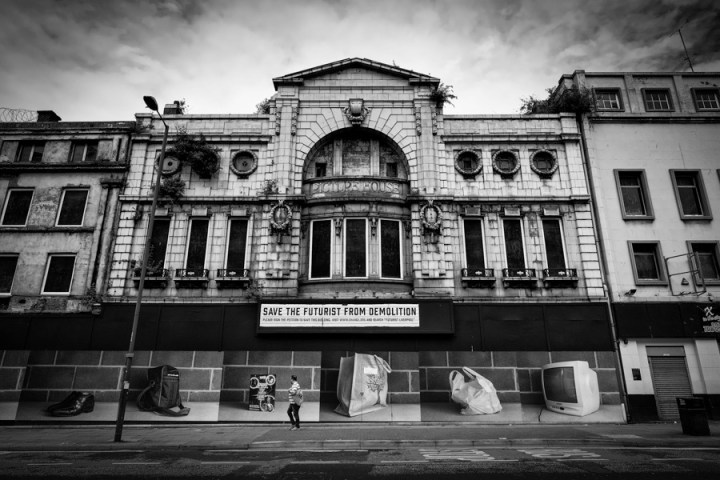
Unfortunately even in the city centre some buildings are still struggling for survival, like this wonderful old cinema. Developers want to knock this lot down and replace it with something bland and ‘modern’. Sadly the Futurist is not listed or in a conservation area so its future looks pretty bleak. Another one to photograph and appreciate while it’s still there.
Eclectic Skyline[exif id=”1022″]

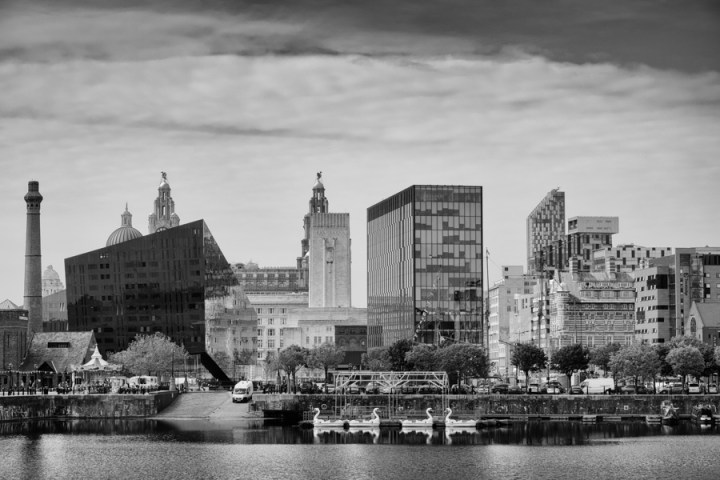
I thought I’d end with this shot of the eclectic Liverpool skyline, as I think it sums up the battle being fought between those seeking to modernise the city and those trying to protect its heritage. It’s a delicate balance to achieve and at the moment it feels like the heritage side is losing out to commercial interests keen on filling now vacant land with generic apartment blocks and commercial buildings. So much so that UNESCO has Liverpool on its list of world heritage sites in danger. Let’s hope sense prevails and that the important, and in many cases beautiful, old industrial buildings can be brought back in to use as part of a modern Liverpool.

If you enjoy my images and writing please help support me and the site by purchasing a print from my web store here or on Etsy.

From the Archive #5

I’m working on a big post about a recent trip to Liverpool but since it’s not done yet here’s another shot from the archive to tide you over.

Sunshine and Showers

Ynyslas
Nikon D90 28mm, ƒ/9, 1/400s, ISO 125

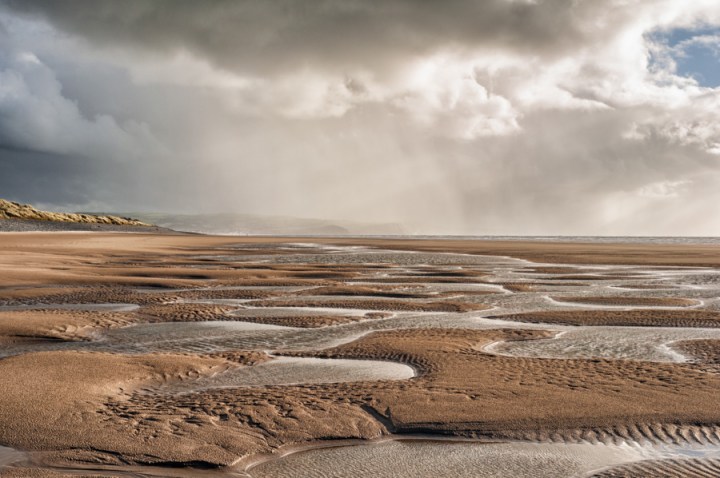
I got this shot while on a wander down the incredible beach at Ynyslas, around 8 miles north of Aberystwyth in mid-Wales. It had been sunny and remained so where I was stood, but in the distance grey clouds rolled in and it began to rain. The light and contrast between the sunny foreground and gloomy background were fantastic.

From the Archives #4

This is the fourth in a series where I share older images that I’m quite proud of but which are unlikely to otherwise appear here.

Torii Stickers

Torii Stickers

Nikon D90, 50mm, ƒ/4.5, 1/200s, ISO 200

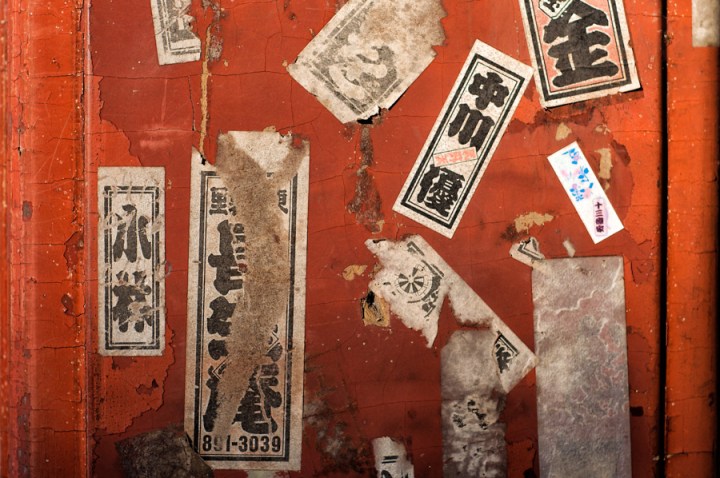
This is a detail of a torii gate at a shrine in Ueno park, Tokyo. I took this on my first trip to Japan in 2009, which feels like a very long time ago now! I’m not sure why it’s adorned with stickers, perhaps from local sponsors or businesses wishing for good luck? At any rate I liked the textures and colours.

Handmade Parade 2015

Handmade Parade 2015

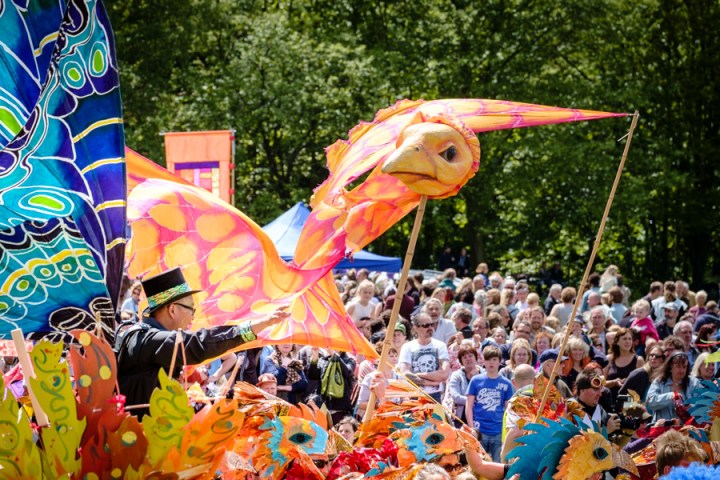
Every year the small market town of Hebden Bridge, nestled in the Pennines, bursts to life with the vibrant and magical Handmade Parade. The various floats, puppets and multitude of costumes are created by local residents around a theme that’s picked by the public. This year’s theme was “Come fly with us” and featured everything from birds to giant insects and aliens to crazy flying machines.

This year I shot the parade with the following gear; my trusty (but increasingly long-in-the-tooth) X-E1, XF 14mm f2.8, XF 27mm f2.8 and XF 55-200mm. This the first year I’ve shot the parade without a fast prime and there were some occasions where I missed having one. The 55-200 can produce good subject separation, but the bokeh can be quite busy in some circumstances.

_DSF6752[exif id=”958″]

The parade was led by a jovial pair of air traffic controllers.

In a spin[exif id=”965″]

When you’re close to the action the 14mm lens is great to fill the frame with multiple subjects.

_DSF6839[exif id=”963″]

_DSF6842[exif id=”964″]

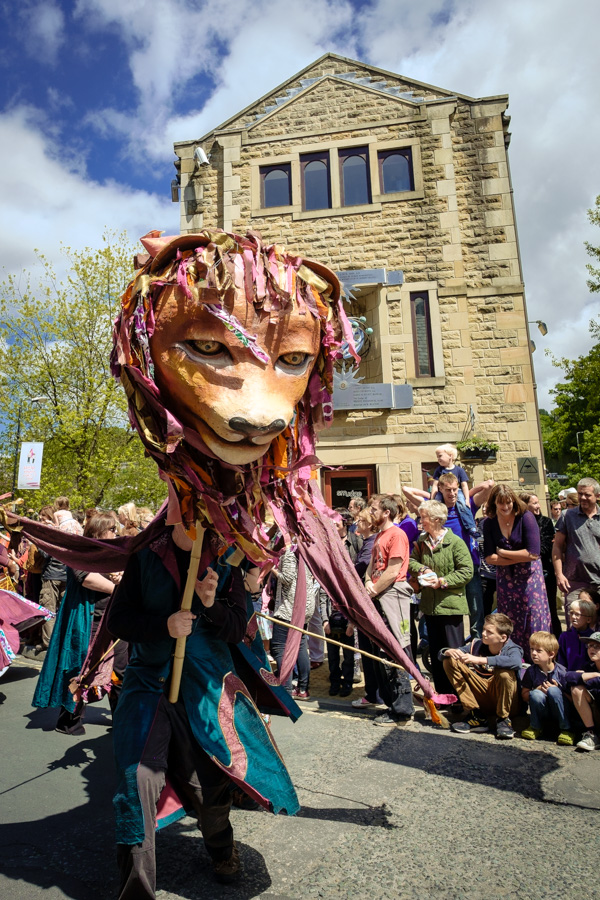
I’m not sure how the raggedy lion fit with the theme but it was cool all the same.

_DSF6793[exif id=”960″]

_DSF6775[exif id=”959″]

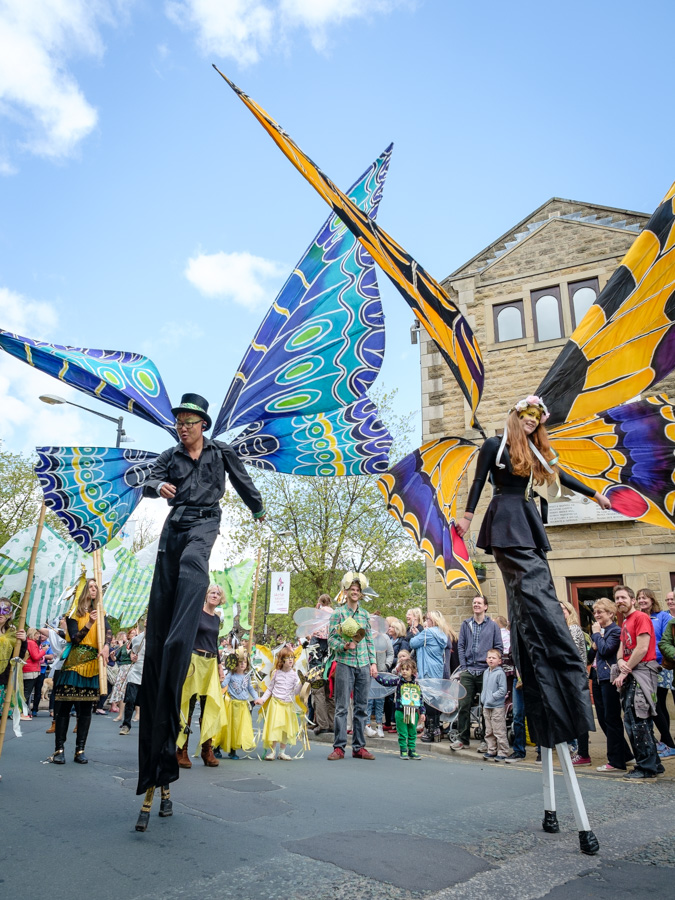
There are always some impressive stilt walkers in the parade. These two in butterfly costumes were particularly impressive and given the reasonably strong gusts of wind still blowing through the valley, did a good job in staying upright! Choosing a low angle is great of accentuating the height of tall subjects.

_DSF6802[exif id=”961″]

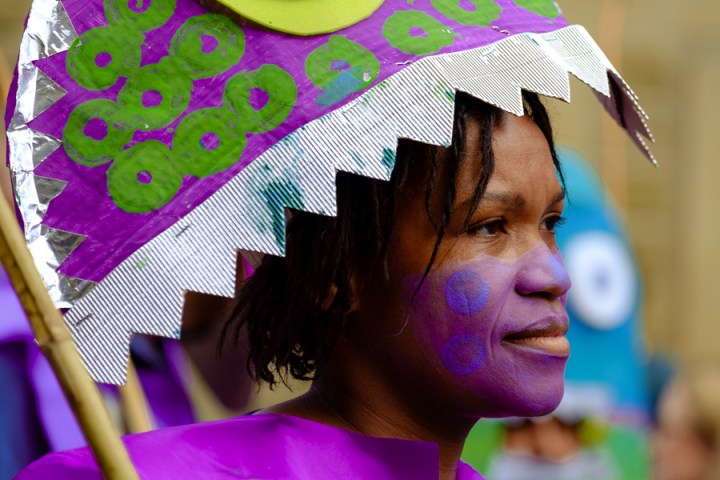
As I mentioned above you can get some nice subject isolation with the 55-200 and at closer distances the bokeh is smooth and creamy. Framing can be more of a challenge during a fast moving parade though. In previous years I’ve used the 60mm f2.4 for this kind of shot and while it was easier to handle, the slow focusing could ruin shots. I’d love to try a 56mm f1.2 for this, but that will take quite a few print sales to make a reality!

_DSF6915[exif id=”967″]

_DSF6824[exif id=”962″]

If you enjoy my images and writing please help support me and the site by purchasing a print from my web store here or on Etsy. If you would like to see my images from the 2014 Handmade Parade click here.

From the Archives #3

This is the third in a new series where I share older images that I’m quite proud of but which are unlikely to otherwise appear here.

Darwin’s Seat

Darwin's Seat[exif id=”950″]

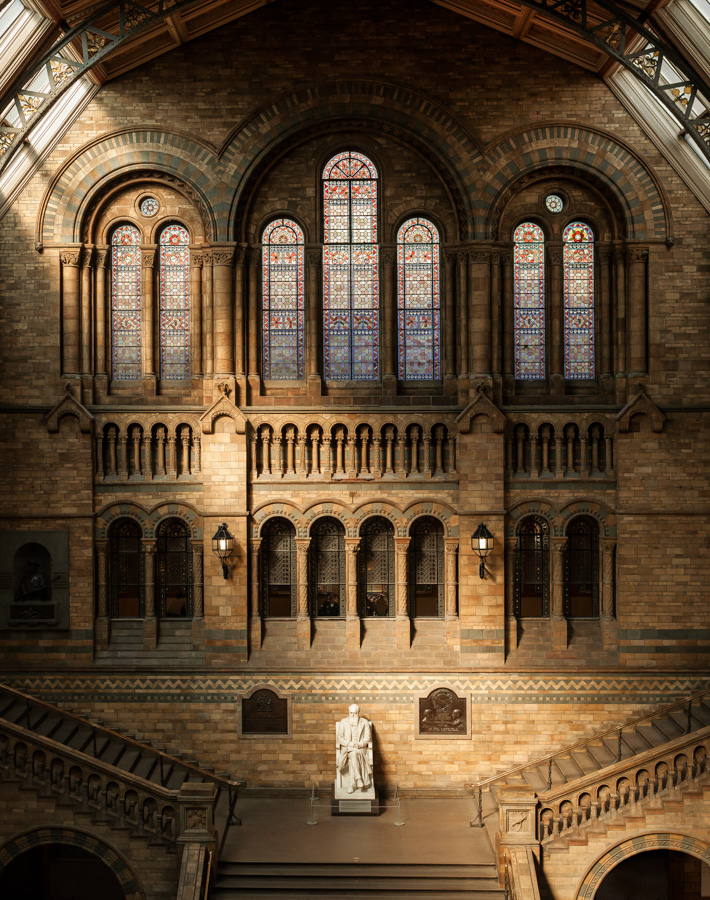
I love this image of Darwin’s statue in the Natural History Museum in London. It’s a beautiful building, full of intricate details and flourishes. The natural light streaming in from the high windows on a sunny day picks out the details in the stonework really nicely. I only had a 50mm f1.8 prime with me at the time, so in order to get everything I wanted in this image I had to stitch two photos together in Photoshop. If you search for images of the Natural History Museum you’ll see many photos looking up the hall towards Darwin’s statue, but mostly taken with wide-angle lenses that give a very different perspective.

From the Archives #2

This is the second in a new series where I share older images that I’m quite proud of but which are unlikely to otherwise appear here.

Getting Lost in a Maze of Torii

Getting Lost in a Maze of Torii
[exif id=”944″]

This shot is from Fushimi Inari-taisha, a large Shinto shrine complex near Kyoto, famous for its tunnels of brightly painted torii gates. I’ve visited this shrine on several occasions now, but the most memorable visit was my last in 2011, as it was the first time I’d been after dark. As a popular spot with both locals and tourists, the various shrines that make up Fushimi Inari are usually busy, with lots of people coming and going through the maze of torii gate dotted paths that criss-cross the mountain between the various shrine buildings. At night however the place is almost entirely deserted, leaving you to explore in peace. With the rattle of shrine bells, claps, quiet mummers of prayer and chatter all absent, the place is eerily quiet. The mountain already has a rather other-worldly feel and that is only magnified at night with all but the shrine buildings and gates lost to the darkness.

From the Archives #1

This is the first in a new series where I share older images that I’m quite proud of but which are unlikely to otherwise appear here.

A day at the beach

Day at the Beach
[exif id=”937″]

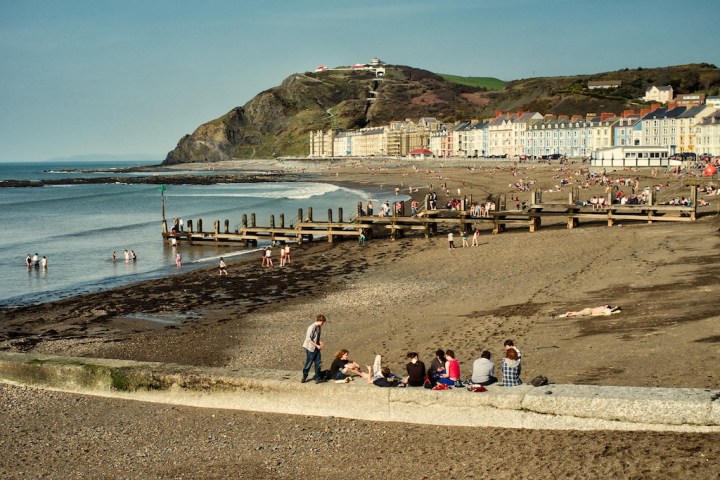
I captured this shot of the beach at Aberystwyth on an unusually warm late March day, back in 2012. I lived in this town for the best part of a decade before moving to Yorkshire, so I have a lot of fond memories for it, many of which are summed up in this shot. Whether having a barbecue on the beach with friends, a lazy wander along the promenade to buy an ice cream in the scorching summer sun, watching the waves crash against the seawall on a stormy day, or climbing Constitution Hill at the far end of the beach. Good times! In a further play to my own nostalgia, I’ve processed the image to give it a slightly desaturated filmic look.

Project: Leaving a Mark

Project: Leaving a Mark

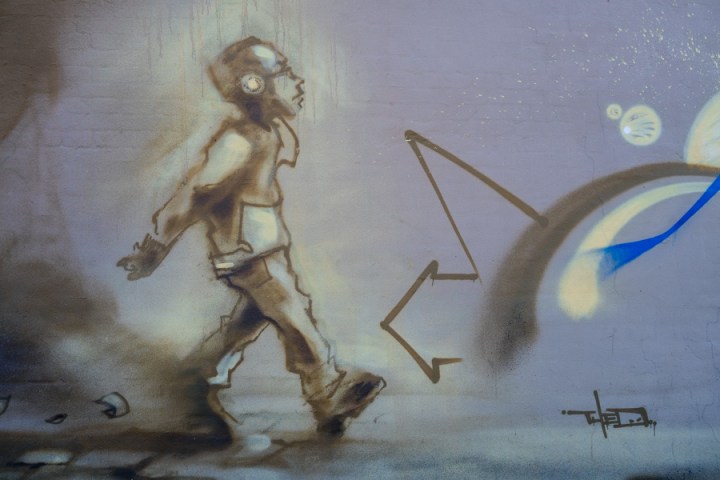
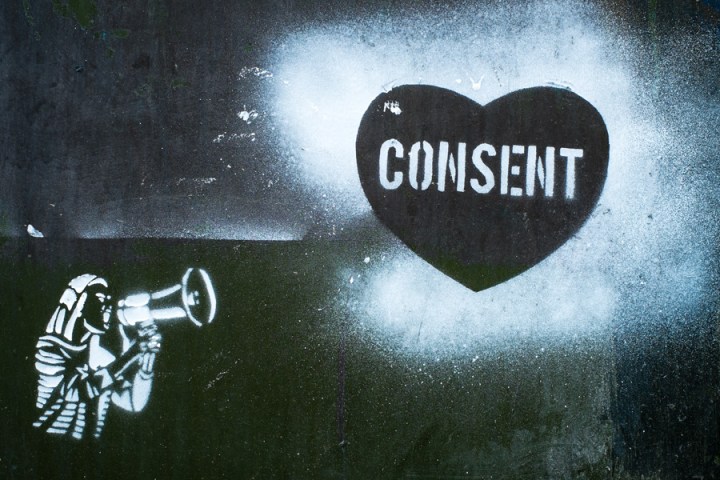
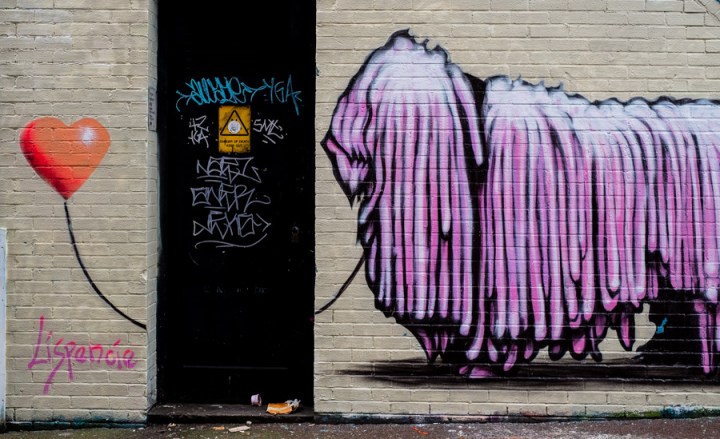
I’ve been photographing street art and graffiti for several years now, where ever I come across it. From hasty scrawls to detailed artworks, abstract patterns to political messages. Graffiti can be a controversial subject; some people think it’s urban blight, has no value or is simply vandalism. It certainly can be all of those things, but that doesn’t change that it’s still fundamentally art – a form of human expression, and one that has a history as old as civilisation itself.

What interests me about it, and why I like to photograph it, is both its ephemeral nature and how it forms part of the texture of the world around us. Traditional two dimensional artwork is generally discrete, it has defined borders after which the world it conveys abruptly ends. Grafitti on the other hand does not, its world is our world. This makes it interesting photographically because you can both photograph the artwork itself, or the environment its in, or some combination of the two without the feeling that you’re simply creating a facsimile of someone else’s work.

DSCF9801
[exif id=”919″]

Stencilled pieces, like Silvia and her bike above, are very popular – just look at anything by street artist Banksy. Personally though I prefer the painted on the spot type, as they are more spontaneous and have a uniqueness that stencilled works can’t match.

DSCF0137
[exif id=”909″]

I love the dual textures in this detail shot, the fine paint flecks that make up the eye against the rough and ready chipboard it’s painted onto. Below is a detail of another, more abstract piece. Spray painted works that are done well usually have a fantastic feeling of energy about them.

DSCF7452
[exif id=”923″]

DSCF1241
[exif id=”911″]

Typically when you think of what’s used for graffiti, spray cans are the first thing that comes to mind. But most of us will have encountered many other forms – names and doodles scratched into tables, initials carved into tree trunks, expletives in marker pen on the back of toilet doors and so on. I’ve noticed that hand drawn stickers seem quite popular locally. These micro artworks add little splashes of colour to places that would be difficult to turn into canvasses with other mediums.

DSCF2527
[exif id=”913″]

One of the perks of living in a fairly bohemian area, is that you’re probably more likely to run into something a little more thought provoking than your usual initials, tags and doodles. Whether poetic or political in nature as these pieces above and below.

DSCF6324
[exif id=”916″]

DSCF4729
[exif id=”914″]

Even fairly ugly pieces can make for interesting photographs. There are some great colours and textures in this decaying old garage door. The silver spray painted face (or whatever it is) shines brilliantly when ever the sun hits it, in sharp contrast with the dreary old green paint and rust stains.

DSCF2009
[exif id=”912″]

In a world where every building in a city can have a CocaCola or a Visa logo present, I guess it’s only natural that people want to reclaim some of that space to express their own identity. Tagging is probably the most controversial form of graffiti, usually due to its repetition, frequent lack of obvious artistic merit and the way in which it appears to try to wrest a territory for its creator. It’s an aggressive form of the art. Like planting a flag on foreign soil, tagging is staking a claim on someone else’s property in a way that I feel more artistic pieces are not. Photographically I usually find tags on their own fairly uninteresting, instead it becomes about context. In the shot above the “Lovecats” mark is atop another, painted over tag, beneath a plethora of threatening signs. The tag on its own is meaningless, but in this context you get the sense of fighting against the rules, defying the wall’s owner’s attempts at silencing past expression. It’s hardly profound, but it’s a story nonetheless and makes the image more interesting.

DSCF9051
[exif id=”918″]

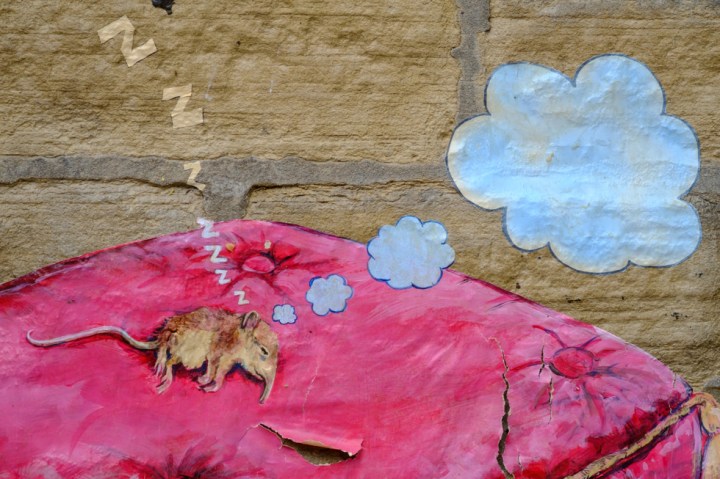
A lot of effort clearly went into this piece, but it was very short lived, which I think highlights why it’s important to photograph these things and create a lasting record. Unusually it was made of painted paper, and as a result it began to deteriorate within a few days. I assume this method was used to avoid making any lasting damage to the old stone wall, which was considerate of the artist.

DSCF9487
[exif id=”922″]

This detail of the artwork shown above was taken just a few days later and shows the paper starting to crack and peel. The artwork was removed entirely not long after.

DSCF5002
[exif id=”924″]

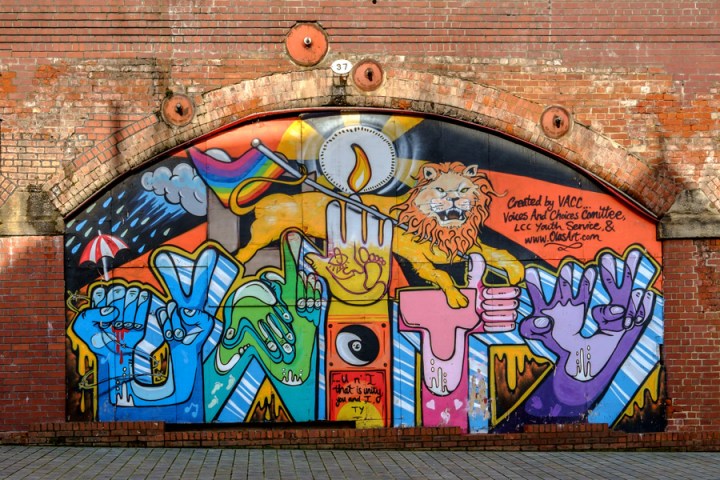
Big commissioned murals like the one above can actually help rejuvenate an area, which nicely counters the idea that graffiti is only a sign of urban decay. The old brick railway arch makes a lovely frame for this piece.

_DSF3914
[exif id=”929″]

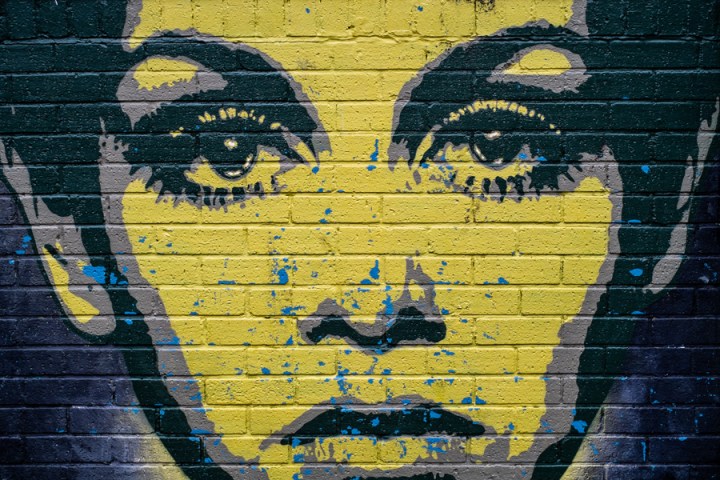
Brickwork can add great texture and becomes as much a part of the artwork as the paint itself.

_DSF3919
[exif id=”930″]

Some colourful graffiti can really improve otherwise bland, utilitarian buildings like the enclosed electric substation above.

With exception of the feature image at the top of this article, which was taken in Copenhagen, all the other images have been taken around Hebden Bridge, Leeds and Manchester in Northern England.

Unlike past project pieces I’ve written up here, I consider this one on-going and I’ll continue to document interesting street art and graffiti as I come across it. I hope you’ve enjoyed looking at these images. As ever if you’d like to help support the site and my work please consider buying a print from my web store or on Etsy.